





DTF Printer Maintenance vs. Outsourcing: The 2026 Guide to Printing Profit

What Is This Article About?
Losing 10 hours a week to a clogged printhead isn't just a technical glitch. It's a $19,500 annual leak in your profit margin. You want the control of in-house production, but the constant battle with humidity and nozzle checks feels like a second job you didn't apply for. It's frustrating to watch high shipping costs eat your margins while your hardware sits idle. We know that every minute spent cleaning an i3200 printhead is a minute you aren't selling.
This guide clarifies the debate over dtf printer maintenance vs outsourcing by showing you the real numbers for 2026. You'll discover the exact break-even point where owning a printer actually makes sense for your specific volume. We promise to help you choose the most profitable path for your apparel brand, whether that means mastering your own hardware or partnering with a reliable expert. We're going to break down essential maintenance costs, the price of professional hardware, and how to eliminate technical headaches. It's time to stop guessing and start scaling with precision.
Key Takeaways
- Calculate the true cost of "Hidden Labor" by translating daily maintenance rituals into annual hours of lost production time.
- Identify your specific break-even point for dtf printer maintenance vs outsourcing to ensure your equipment isn't draining your bank account.
- Leverage the Richardson and Dallas-Fort Worth local advantage to eliminate high shipping costs and long turnaround times for custom transfers.
- Build a strategic "Safety Stock" of essential hardware parts to prevent catastrophic production delays and expensive printhead failures.
- Master a hybrid strategy that combines the speed of in-house printing for small runs with the massive scale of professional outsourcing for bulk orders.
The DTF Dilemma: Comparing In-House Control with Outsourced Ease
Every apparel brand eventually hits a crossroads. Do you buy the machine or do you buy the service? The choice between dtf printer maintenance vs outsourcing isn't just a hardware decision. It's a business strategy. In-house printing offers the ultimate allure of total control. You can fix a typo on a gang sheet in minutes. You can print a single custom shirt for a walk-in customer. On paper, your per-print costs look incredibly low. But that control comes with a technical tax that many entrepreneurs underestimate. It's the difference between being a creative director and a full-time repair technician.
The 2026 landscape has matured significantly. Direct-to-film (DTF) printing is now the industry standard for versatility, but the hardware remains temperamental. Professional-grade printers in the $10,000 to $25,000 range have improved white ink circulation, yet they still demand daily attention. This has led to the rise of the hybrid model. Smart brands are keeping small, entry-level units for "oops" moments and rush samples while outsourcing their heavy lifting to industrial hubs. They get the speed of local control without the overhead of a massive print floor. It's about maximizing profit while minimizing technical friction.
When In-House Printing Makes Financial Sense
Owning your equipment is a volume game. If you aren't running your printer daily, you're losing money. DTF ink is a "use it or lose it" consumable. A printer that sits idle for three days is a printer that's about to cost you a $350 printhead replacement. You also need a strictly climate-controlled environment. We're talking 40-60% humidity and stable temperatures. Without this, your ink won't cure and your heads will clog. Finally, you need a dedicated "hardware person." If you aren't comfortable with a syringe, lint-free swabs, and RIP software, the DIY route will quickly become a nightmare.
The Freedom of Outsourcing Your Transfers
Outsourcing is the ultimate shortcut to professional quality. It eliminates the "White Ink Headache" from your morning routine. You don't have to shake bottles, wipe capping stations, or run nozzle checks before you can start your day. Instead, you focus on marketing, sales, and customer experience. When you outsource to a pro, you're leveraging industrial-grade equipment that delivers perfect color matching every time. You pay for the finished transfer, not the wasted film or the $900 i3200 printhead. It’s a clean, scalable solution that lets you grow your brand without turning your garage into a chemistry lab.
The True Cost of DTF Printer Maintenance: Parts, Labor, and Downtime
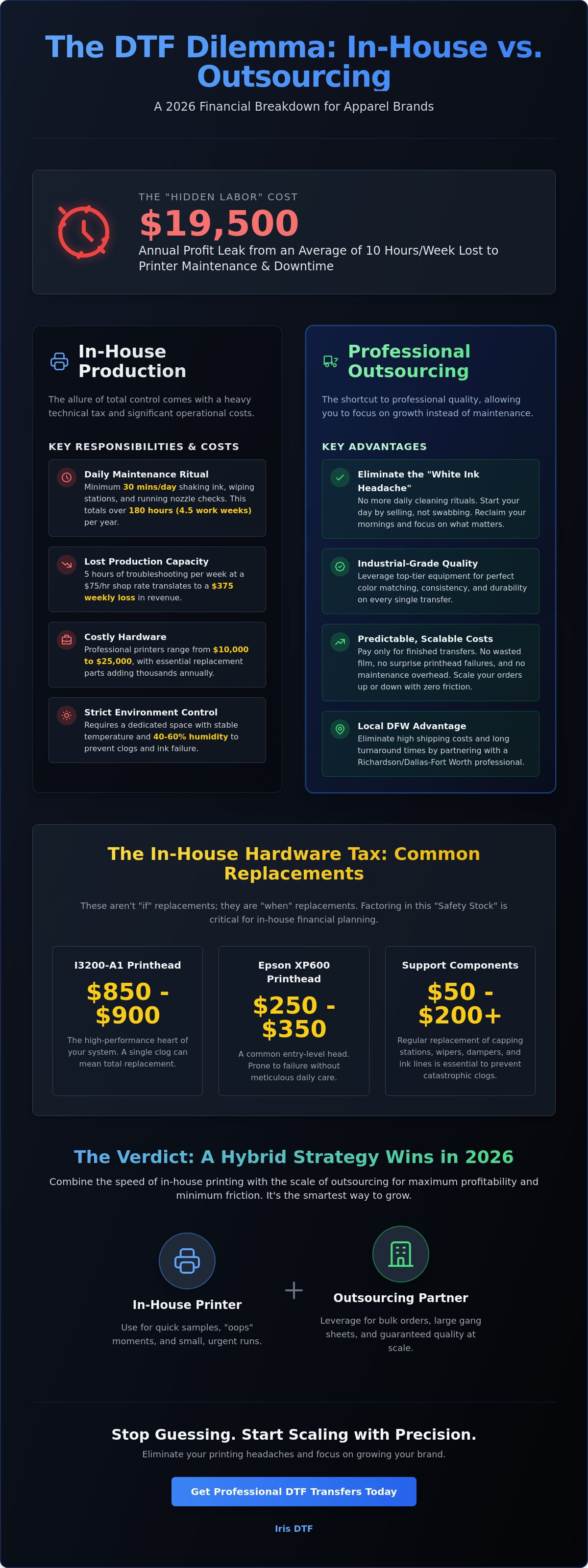
Maintenance isn't just a chore. It's a line item on your balance sheet. Many apparel brands budget for ink and film but ignore the clock. Every morning begins with the same ritual. Shake the white ink bottles. Wipe the capping station with lint-free swabs. Run a nozzle check. If the pattern is broken, you run a cleaning cycle. Then you repeat. This process eats at least 30 minutes of your most productive morning hours. Over a year, that adds up to 180 hours of "Hidden Labor." That is over four full work weeks spent just keeping the machine alive instead of growing your brand.
The financial impact of dtf printer maintenance vs outsourcing becomes clear when you look at lost capacity. According to the 2026 printing industry outlook, efficiency and automation are the primary drivers of modern profitability. Manual maintenance is the opposite of that trend. If your shop generates $75 per production hour and you lose five hours a week to troubleshooting, you're losing $375 every week. That is nearly $20,000 in annual revenue sacrificed to hardware upkeep. For many, that's the difference between a side hustle and a sustainable business.
The Critical Components Checklist
Printheads are the heart of your system. They are also the most fragile. An Epson XP600 replacement costs between $250 and $350. Stepping up to an I3200-A1 means a $850 to $900 hit per head. These aren't "if" replacements; they are "when" replacements. Capping stations and wipers are the unsung heroes. If the rubber seal on your capping station isn't airtight, the head dries out overnight. Ink dampers and lines act as the printer's veins. They require replacement every few months to prevent sediment buildup from causing catastrophic clogs. If these parts fail, your production stops instantly.
Environmental Impact on Hardware Longevity
DTF hardware is notoriously sensitive to its surroundings. Humidity must stay between 40% and 60% at all times. If the air gets too dry, ink starves and heads clog. If it's too humid, your film won't cure. Texas heat is a known enemy of DTF stability. High temperatures can cause ink separation and make transfer film tacky. Dust management is equally vital. A single speck of dust on the film can cause a pinhole in a $15 transfer. If you aren't ready to manage a climate-controlled clean room, you can avoid the technical burden by ordering custom DTF transfers from a professional hub.
Why Outsourcing to a Dallas-Fort Worth Pro Wins on Speed
Speed is the currency of the apparel industry. If a customer wants 50 shirts by Friday, you can't afford a clogged printhead on Tuesday. Many shop owners assume printing in-house is faster because the machine is right there. The reality of dtf printer maintenance vs outsourcing often proves the opposite. When you factor in cleaning cycles, failed prints, and slow curing times on entry-level ovens, the DIY route can actually throttle your growth. A professional hub in Richardson or Dallas runs industrial-grade equipment designed for continuous 24/7 output. They don't struggle with registration or ink density. They just produce.
One of the top reasons small businesses outsource is to bypass the massive capital investment required for high-capacity manufacturing. You get access to $50,000 setups without the debt. This allows you to scale instantly. If you suddenly need 100 gang sheets, an in-house entry-level printer might take 20 hours to finish. A professional shop handles that volume in a fraction of the time. You aren't just buying transfers. You're buying the capacity of a powerhouse.
Local Logistics in the Dallas Metroplex
Location is your greatest asset. For apparel brands in Plano, Frisco, or Richardson, local pickup changes the game. You stop being at the mercy of nationwide shipping delays. You place an order in the morning and pick it up the same afternoon. This local loop allows for custom rush jobs that would be impossible if you were waiting on a delivery truck from across the country. Building a relationship with a North Texas provider means you have a partner who understands your deadlines. It's a logistical shortcut that keeps your customers happy and your shop running lean.
The "Invisible" Savings of Outsourcing
The savings go beyond the price per print. Industrial curing ovens and high-speed printers pull massive amounts of power. When you outsource, your electricity bill stays flat. You also eliminate the headache of hazardous waste disposal. DTF powder and liquid ink waste require specific handling that can be a regulatory burden. By moving production off-site, you also reclaim valuable square footage. Instead of a room filled with noisy printers and curing fumes, you have space for finished inventory and a clean showroom. It's a more efficient way to work.
Essential Hardware and Replacement Parts for In-House Success
If you choose to keep production internal, your hardware strategy must be proactive. The debate over dtf printer maintenance vs outsourcing often hinges on one factor: uptime. You can't afford to wait three days for a replacement part while orders pile up. Success in-house requires a "Safety Stock." This means having critical components on your shelf before they fail. A $10 wiper or a $20 damper can halt a $5,000 order. Don't let a small part become a massive bottleneck. Professional shops treat hardware parts as insurance for their profit margins.
Upgrading from hobbyist to professional components is the fastest way to stabilize your workflow. Standard dampers often struggle with the density of DTF white ink. They clog. They leak. Professional-grade dampers feature reinforced filters designed to maintain high flow rates even during 10-hour shifts. This prevents the banding and ink starvation that ruin expensive film rolls. High-quality cleaning kits are equally vital. These aren't just luxury items. They are your first line of defense against a $900 printhead replacement. Consistent cleaning extends the life of your hardware and ensures every gang sheet meets professional standards.
Top Picks from the Iris DTF Hardware Collection
Iris DTF offers a curated selection of components designed for maximum durability. We provide replacement printheads that deliver the exact registration and color density your customers expect. Our all-in-one maintenance kits simplify your daily and weekly upkeep. They remove the guesswork from hardware management. If you want to improve your printer's efficiency, start with better parts. You can shop the full range of Replacement Parts & Hardware Upgrades to keep your machines running at peak capacity. We focus on the tech so you can focus on the prints.
Common Mistakes in Hardware Selection
The most expensive part you'll ever buy is a "cheap" generic one. Generic dampers and capping stations often lack the airtight seals required for DTF stability. If your capping station doesn't create a perfect vacuum, your printhead will dry out overnight. This turns a simple maintenance task into a catastrophic repair. Another common error is failing to replace dampers every 3 to 6 months. These parts are consumables. They wear out. They accumulate sediment. Regular replacement is a small price to pay for consistent quality. If you want to avoid these technical hurdles entirely, you can always stock up on DTF supplies and focus on your core business instead of repairs.
Reliability isn't an accident. It's the result of using the right parts and following a strict schedule. Whether you are replacing a printhead or just swapping a wiper blade, quality matters. Your hardware is the engine of your apparel brand. Keep it tuned, keep it clean, and keep your profit margins healthy.
The Verdict: Choosing Your Path to Apparel Printing Profit
Deciding on dtf printer maintenance vs outsourcing isn't a one-time choice. It's an ongoing audit of your time, resources, and growth goals. For many successful brands in 2026, the answer isn't "either/or." It's "both." The hybrid strategy has become the gold standard for profitable shops. You keep a small, well-maintained unit in-house for immediate samples and rush corrections. You outsource your high-volume gang sheets to a professional hub. This approach protects your schedule from hardware failure while keeping your per-print costs low on bulk orders. You get total control without the total technical burden.
Before you commit to a path, run a final ROI checklist. Factor in the 180 hours of annual labor required for daily rituals. Account for the "Safety Stock" of parts needed to prevent catastrophic downtime. Most importantly, consider your mental health. A clogged printhead at 10:00 PM on a deadline night has a cost that doesn't show up on a spreadsheet. If you want to focus on design and sales, outsourcing is your shortcut to sanity. If you love the mechanics, lean into the DIY route with the right support and professional components.
Decision Matrix: In-House vs. Outsourced
- Low Volume (Less than 20 shirts/week): Outsource every time. The ink waste from daily maintenance cycles will likely cost more than the profit on the shirts.
- Mid Volume (20-100 shirts/week): The Hybrid Sweet Spot. Print your rush samples and one-offs in-house. Send your main production runs to a pro to ensure color density and save labor.
- High Volume (100+ shirts/week): Invest in pro-grade hardware. At this scale, the labor cost is justified, provided you use industrial parts and follow a strict maintenance schedule.
Start Your Journey with the Right Gear
Iris DTF is built to support your brand at every stage of this journey. We are a local Richardson partner focused on speed and professional reliability. Whether you need us to handle your custom transfers or you need the professional components to keep your own machines running, we have the solution. From small start-ups to high-capacity commercial shops, we provide the technical engine for your creative success. We don't just sell supplies; we provide the momentum you need to scale.
Don't let subpar components or technical clogs slow your production. Check out our Replacement Parts & Hardware Upgrades to keep your shop running at peak efficiency. If you're in the Dallas-Fort Worth area, contact Iris DTF for expert advice and local service. We'll help you audit your current volume and technical capacity to find your most profitable path forward. Let's get to work.
Scale Your Brand with Precision and Profit
Success in 2026 isn't about working harder; it's about printing smarter. We've broken down the critical balance of dtf printer maintenance vs outsourcing to show you exactly where your time and money go. Whether you choose the total control of in-house production or the streamlined ease of local outsourcing, your strategy must be built on reliability. The hybrid model offers the best of both worlds, giving you the flexibility to sample in-house while scaling bulk orders with professional precision.
Iris DTF provides the technical engine for your creative vision. With over 10 years of US DTF expertise and a local facility in Richardson, we understand the unique demands of Dallas and North Texas brands. We stock a comprehensive collection of 34+ professional hardware components to ensure your shop stays operational. Stop losing production hours to hardware failure and start focusing on your growth.
Ready to optimize your workflow? Browse Replacement Parts & Hardware Upgrades to find the exact components you need for success. Your path to a more profitable apparel brand starts here. Let's get to work.
Frequently Asked Questions
How often do I really need to perform DTF printer maintenance?
Daily maintenance is mandatory for every DTF system. You must shake your white ink bottles, wipe the capping station with lint-free swabs, and run nozzle checks every morning. This 30 minute ritual prevents ink from settling and protects your printhead from permanent damage. Skipping even a single day can lead to sediment buildup that requires expensive deep cleaning or part replacement. Consistency is the only way to ensure professional results.
Is it cheaper to print my own DTF transfers or buy them?
The answer depends entirely on your production volume. When evaluating dtf printer maintenance vs outsourcing, you'll find in-house material costs range from $1 to $2.50 per print. However, outsourcing typically costs $3.50 to $5 per transfer without the technical overhead. If you aren't printing at least 20 items a week, the cost of wasted ink and "Hidden Labor" often makes outsourcing the more profitable choice for your brand.
What are the most common replacement parts I should keep on hand?
You should always keep a "Safety Stock" of dampers, wipers, and capping stations. These components are inexpensive but critical for daily operation. Dampers should be replaced every 3 to 6 months to maintain consistent ink flow. Having these parts on your shelf prevents a $10 failure from halting a $5,000 order. If you run high volumes, keeping a spare printhead is also a smart insurance policy against unexpected downtime.
Can I leave my DTF printer sitting for a week without use?
Absolutely not. DTF ink, especially white ink, contains heavy pigments that settle quickly when idle. If a printer sits for a week without a circulation system running, the ink will likely clog the dampers and the printhead. This often results in a total hardware failure. If you plan to be away, you must either have someone run daily test prints or perform a full system flush with cleaning solution.
What is the lifespan of a DTF printhead?
A well-maintained printhead typically lasts between 6 and 18 months. Lifespan varies based on ink quality and maintenance frequency. Entry-level heads like the Epson XP600 cost $250 to $350, while professional i3200 heads can cost $850 to $900. Industrial heads like the Uninet 6000 can reach $1,299. High-quality ink and daily capping station wipes are the best ways to push your hardware toward that 18 month mark.
How does humidity affect my DTF printer hardware?
Humidity is a critical factor for ink stability and hardware health. You must maintain a climate-controlled environment between 40% and 60% humidity. If the air is too dry, ink will dry inside the nozzles and cause starvation. If it's too humid, your film may become tacky and the powder won't cure correctly. In the Texas heat, using a dedicated humidifier and hygrometer is essential for preventing catastrophic clogs.
Should I upgrade my hobbyist printer or just outsource to Iris DTF?
Upgrade your hardware only if your consistent volume justifies the labor. If you're currently in the "Hybrid" sweet spot of 20 to 100 shirts a week, outsourcing bulk orders while keeping a small unit for samples is often best. Hobbyist printers require significantly more manual intervention than professional systems. Partnering with Iris DTF for your larger runs allows you to leverage industrial-grade density and speed without the $50,000 equipment overhead.
What is the best way to clean a clogged DTF printhead?
Use a syringe and specialized cleaning solution to gently flush the head. Never force the liquid through, as this can rupture the internal membranes. If a simple flush doesn't work, soak the printhead in a shallow tray of solution for several hours. If the clog persists for more than 48 hours, the ink has likely cured inside the nozzles. At that point, replacement is usually the only way to restore professional print quality.